[01] Why the Style Travels
Most of what defines noir, an unreliable narrator, a morally compromised protagonist, a plot built on concealed motive, does not actually require a camera. Chiaroscuro lighting is the one element tied specifically to cinematography, and even that has a close equivalent in high-contrast ink illustration. Once the devices are understood as a toolkit rather than a film-only style, it becomes clear why writers, artists and game designers working in other media have reached for the same tools repeatedly.
[02] Prose Fiction After the Pulps
![[02] Prose Fiction After the Pulps : Noir Beyond Cinema: Fiction, Comics and Games](/images/02-prose-fiction-after-the-pulps-noir-beyond-cinema-fiction-comics-and.jpg)
The hard-boiled tradition covered in chapter three never actually stopped; it continued as a living branch of crime fiction well past the classic film period. Writer James Ellroy, whose novel "L.A. Confidential" is discussed in chapter ten, is one of the clearest examples of a contemporary novelist working explicitly within the tradition, setting his fiction in the same historical Los Angeles that classic and neo-noir films return to.
Crime fiction more broadly has kept the hard-boiled voice, the first-person narrator, the terse prose, the morally compromised protagonist, available as an ongoing option rather than a closed historical style.
[03] Comics and Graphic Novels
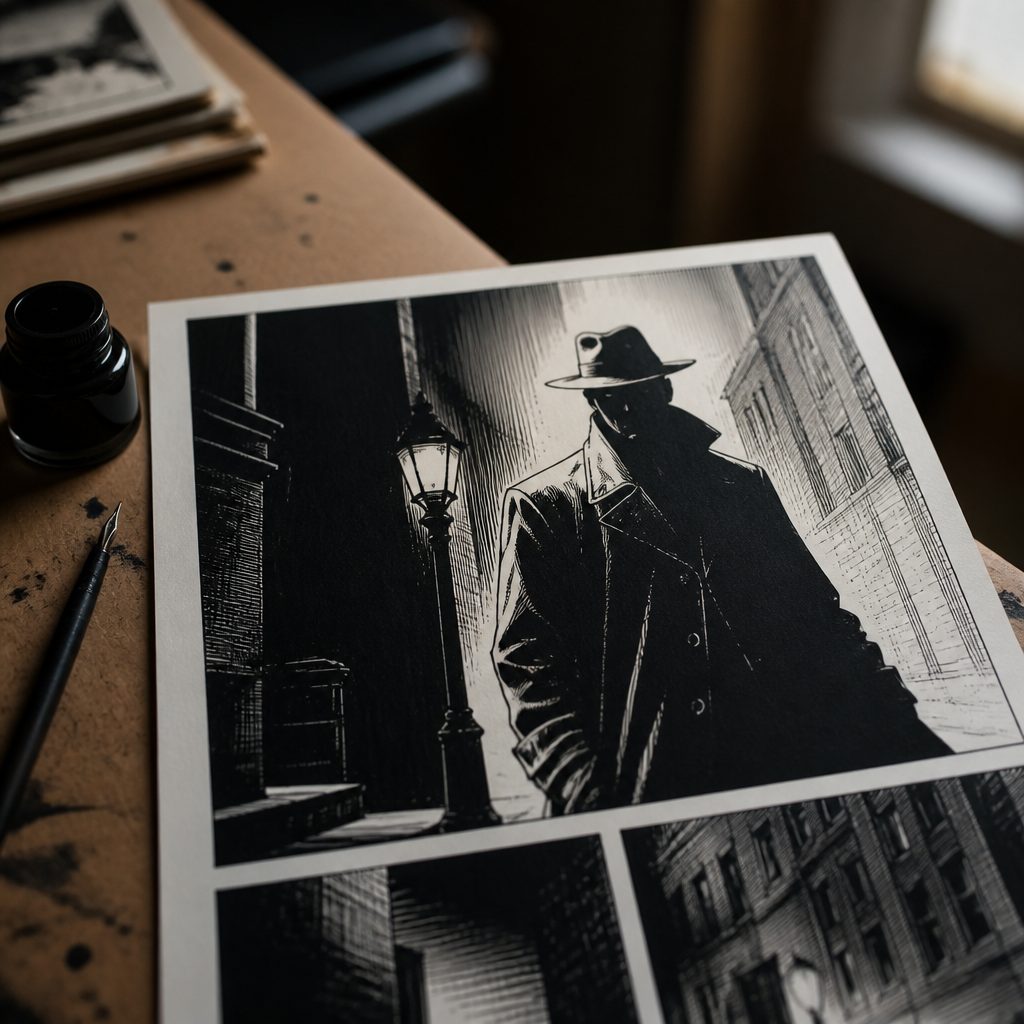
Comic art translates chiaroscuro almost directly: heavy black ink standing in for deep shadow, and a light source implied by where the ink is withheld rather than applied. Will Eisner's newspaper comic strip "The Spirit," running through the 1940s, is often cited by comics historians for lighting and framing choices that closely parallel contemporary film noir cinematography, applying the same visual grammar to a page instead of a screen.
Later graphic novels have continued the association, often pushing the black-and-white contrast principle further than live-action cinematography reasonably could, since a drawn panel is not constrained by an actual light source the way a film set is.
[04] Interactive Fiction and Games
![[04] Interactive Fiction and Games : Noir Beyond Cinema: Fiction, Comics and Games](/images/04-interactive-fiction-and-games-noir-beyond-cinema-fiction-comics-and.jpg)
Detective and investigation-driven video games borrow noir's structure in a way few other media can: a player piecing together a case from partial information mirrors, mechanically, the withheld motive and delayed revelation that drive a noir plot. Games in this mode frequently use voiceover narration and stylized high-contrast lighting directly, treating the devices covered in part two of this guide as design tools rather than only storytelling ones.
What changes in an interactive setting is pacing: a reader or viewer receives information on the author's schedule, while a player often controls how quickly a mystery unfolds, which puts real weight on how well a design withholds information without simply frustrating the player.
The final chapter turns this outward-looking view into a practical tool: a checklist for recognizing noir influence in something released this year.